

 BipMedia.be Nouvelles

Related Articles


BRUSSELS, 25 February (BIPMedia)
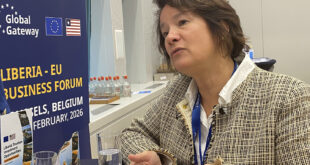
Meeting the urgent need for energy and infrastructure in several sectors in Liberia and attracting more European investors, is the central idea behind the Liberia-European Union Business Forum being held in Brussels on 24 and 25 February 2026. In a joint interview with Agence Europe and Brussels Information Press, Nona Deprez, EU Ambassador to the Republic of Liberia, emphasised the importance of this first Liberia-EU trade portal in launching the major projects Liberia needs for its development and the fight against poverty.
Launched on 24 February in Brussels, the capital of Belgium and seat of the European institutions, the Forum brings together investors, businesspeople, business leaders, policy makers, development partners and the Liberian diaspora in Europe to build bridges and showcase Liberia’s assets and business opportunities for European investors and other partners. This forum is primarily dedicated to investment in Liberia, with a view to increasing trade cooperation between the EU and Liberia.
Devastated by the long civil war from 1989 to 2003, which destroyed most of its road, energy, economic and social infrastructure, including the port of Buchanan, and paralysed foreign trade, Liberia has been a country in reconstruction for years, said Ms Deprez. The Mount Coffee hydroelectric power station, the main national source supplying 70% of the population’s electricity with 88 MW, for example, suffered considerable damage during the 1990 civil war but was brought back into service in 2016, Ms Deprez pointed out.
Several other difficult socio-economic situations have hampered Liberia’s active reconstruction phase. These include the country’s debt relief, under the presidency of Ellen Johnson Sirleaf (2006-2018), the Ebola virus disease (2014-2016), and Covid-19 (2020-2022), Ms Deprez noted.
« Today, Liberia still has an urgent need for energy, road infrastructure, water and sewage systems, etc. Liberia is very poor. Our population is growing very rapidly. It is a stable democratic country, which is very important, » said the EU Ambassador to Liberia, while pointing out that President Joseph Boakai’s regime is making a real effort to improve the business environment in terms of transparency, accountability and the rule of law.
Infrastructure development is a major challenge that Liberia must address, and Ms Deprez highlighted a few key areas. “The roads are in very poor condition. At present, part of the country is inaccessible during the rainy season. There are traffic jams at the port of Monrovia. It takes some time for containers to be moved, so investment is needed”.
Liberia also faces structural challenges in terms of energy production and a lack of skilled labour, for example. « At the moment, the electricity company’s energy production is not sufficient. You have to build your own generators or bring your own generator, which is of course very expensive. The cost of energy is very high, » she continued.
Given Liberia’s assets in terms of natural resources and socio-political stability, Ms Deprez called on European financiers to invest in Liberia and to be pioneers in various fields. There is still a lot of potential to be explored, she said. Much of it has not yet been explored, as there are currently no geological studies in Liberia. I would therefore like to encourage European companies to come and carry out a geological study, and then to take advantage of a fair partnership between Liberia’s wealth and Europe’s capabilities. Ms Deprez invited European investors already present in Liberia to share their experiences. A concrete example comes from the Belgian metallurgical company Arcelor Mittal. This company not only recruits Liberians to do the work, but also trains them. It goes directly to schools to find them. Arcelor Mittal has its own technical and vocational education and training school to ensure that it has a skilled workforce for its activities. The same is true of the Liberian agricultural company that produces rubber (Socfin), for example.
Beyond the above examples, Liberia has adopted a new cooperation approach that prioritises local jobs. In other words, “whenever Liberia grants a concession to a foreign company, it must ensure that it recruits Liberians to do the work”, said Ms Deprez.
The EU is supporting Liberia in its march towards development through several cooperation projects. « The EU and EU Member States have invested heavily in TVET (technical and vocational education and training), which is essential for training a skilled workforce. We are building schools in every region. We are training teachers and also providing state-of-the-art equipment. Automotive, welding, agriculture and carpentry are also areas in high demand by industry.
But we have also invested in roads. The EU combines grants with loans from the European Investment Bank, and we were also among the first investors in hydroelectricity at Mount Coffee. We have ensured electricity distribution in Monrovia. And we are currently electrifying three towns in south-eastern Liberia. We want to do more, we want to invest more”, said Ms Deprez.
Liberia has adopted a set of incentives to attract foreign investors. One example is the government’s recent adoption of regulations on public-private partnerships, which did not exist before. The government is also trying to improve the business climate with tax measures favourable to foreign investors. However, Ms Deprez believes that European investors are looking for long-term predictability. « We must ensure that the rules are not changed overnight and that existing rules are enforced. There are environmental inspections. They should inspect all companies to ensure that everyone is complying with the rules. Predictability and transparency of inspections are really important. It would be good if Liberia set up a one-stop shop. But that is not the case at the moment. »
European companies are seeking fair conditions. They comply with all rules and regulations, but they expect all companies to comply as well. This is good for Liberia because it increases national revenues, which can then be reinvested in Liberia, Ms Deprez insisted.
The Liberian government is also working to set up a one-stop shop for investors. “This would greatly facilitate the creation of businesses, which is not the case at present. The government is also working to digitise all these processes for greater transparency”, Ms Deprez continued.
Fighting corruption and improving good governance are other challenges facing Liberia. Ms Deprez said that the EU will set up a public finance management support program, under which we will provide technical assistance in capacity building to all institutions responsible for integrity in Liberia. We are therefore working closely with the Auditor-General, the Internal Audit Agency, the Liberia Anti-Corruption Commission, the Ministry of Justice, and the Ministry of Finance and Development Planning.
Investment security was not overlooked. Liberia and the EU are working together on maritime security. « We are working on regional maritime security. Within the framework of ECOWAS (Economic Community of West African States) and the Yaoundé architecture (political capital of Cameroon). We have therefore coordinated the maritime presence of our EU Member States with ships arriving and calling at Monrovia, but also conducting surveillance at sea, » Ms Deprez reassured.
This Liberia-EU Business Forum is an ambitious program that also aims to develop the private sector. The organisation of this forum of major companies from all sectors of socio-economic life appears to be a boon for the EU-Liberia partnership, where major decisions are expected to be taken to implement major government structural projects.
“With the European Investment Bank present at this forum, the European Commission and the European Investment Bank together, and hopefully with private investors, we will ensure that the government’s priority investments are taken into account”, concluded Ms Deprez.

Thank you Bipmedia for your coverage of this important event. The attractiveness of African countries, including Liberia, for massive development investments is undeniable, and has often been very inequitable. Shouldn’t Africa first strengthen and empower its Union to have a greater influence in these EU-Africa partnerships?
Thank you Bipmedia for your coverage of this important event. The attractiveness of African countries, including Liberia, for massive development investments is undeniable, and has often been very inequitable. Shouldn’t Africa first strengthen and empower its Union to have a greater influence in these EU-Africa partnerships?